Showing posts with label Sanctuary Asia. Show all posts

19 April 2014

Rani Bagh Botanical Garden Tree Trail - Part 2

Going on with Rani Bagh Botanical Garden Tree Trail, here are more trees,
Elephant Apple(Dillenia indica) is so called as its eaten by elephants. The bitter-sour fruit pulp is also used in India cuisines.
Elephant Apple
Elephant Apple

Elephant Apple
Elephant Apple
Divi Divi(Botanical name: Caesalpinia coriaria, native West Indies and Central America), grows as a large shrub.
Divi Divi
Divi Divi
Cocoa tree(Botanical name: Theobroma cacao, native of Brazil) is an evergreen tree. The fruit contains seed(which is used to make dark cocoa powder) and a significant amount of fat, cocoa butter. The proportion of seed and cocoa butter is accordingly varied to form the dark and white chocolates. Cocoa bean was also used as currency system in pre-columbian Mesoamerican civilization.
Cocoa tree
Cocoa tree
Cocoa tree
Cocoa tree
Garlic Pear(Botanical name: Crataeva religiosa), the nectar filled flowers attracts many insects and birds. At the flowering season, its said to be flooded with butterflies.
Garlic Pear
Garlic Pear
Shivan(Botanical Name: Gmelina arborea Roxb, native to India, Myanmar) is also called poor-man's teak.
Lemon Scented Gum Tree(Botanical name: Corymbia citriodora, native to Australia), is also called Lemon eucalyptus. The tree resembles the Eucalyptus tree. Refined essential oil from the Lemon Scented gum tree is used in insent repellents. This tree can be easily recognised by smelling its leaf, which smells, lemon.
Lemon Scented Gum Tree
Bamboo(Botanical name: Dendrocalamus strictus Nees, native to India): We were narrated with great facts about bamboo. Bamboo is one of the fastest growing plants and the air flow through the hollow plant makes an unusual sound, which keeps the Bamboo forests misterious. Most Bamboo species flower once in 40years or 100years. All plants of the same stock flower at same time, the flowering is followed by death of the plants. Its so said that in North East India, the flowering of Bamboo plants is said to be a sign of bad time, the flowering of the plants increases the rat population, which after Bamboo, feed on the cultivated farms.
Bamboo
Bamboo
Gustavia(Botanical name: Gustavia augusta, native to Tropical and South America): The fruit is drum(tabla) shaped with seeds inside, when shaken makes a tender sound.
Gustavia
Gustavia

Gustavia
Gustavia Fruit
Bottle Brush Tree(Botanical name: Callistemon citratus (Curtis) Skeels (syn. C. lanceolatus Sw.), native to Australia): This gets its name from its flowers which resemble bottle brush.
Bottle Brush Tree
Bottle Brush Tree
Bottle Brush Tree
Bottle Brush Flower
Wild Almonds, which are said to be natives of Middle East and South Asia, look similar to Almonds, but taste bitter.
Ficus Krishnae(Botanical name: Ficus benghalensis L. var. krishnae Almeida, native to India) is also called Krishna's Butter cup. The leaves of the tree have pocket like fold at the base. As per mythology, Lord Krishna who was fond of butter, rolled the stolen butter it this leaf to hide from his mother Yashoda. Since then it retains its pocket like shape.
Ficus Krishnae
Ficus Krishnae
The final trees where the Three Sister Trees. These trees are called three sisters because of their similar shaped leaves,
  • Sita Ashoka(Botanical name: Saraca arborescens Burm. f. [S.asoka (Roxb.) de Willde;S.indica auct. non L.], native to India): There is interesting story behind Sita Ashoka.  Sasoka and Nisoka were two cannibal demons. They get blessed by Matara Swamiji to be born as trees in their next birth. Sasoka, who was born as Ashoka( a-shok, meaning without sorrow) gives shelter to Mother Sita, during her stay in Lanka. His brother Nisoka also reborn as a tall tree, stand outside the graden, gaurding it. Matara Swami will reborn as Sitaphal and mother Sita will eat fruits of this tree, during her stay in Ashokawan.
    Sita Ashoka
    Sita Ashoka


  • Rose of Venezuala(Botanical name: Brownea grandiceps) called as Laal Jumar(red chandelier) in Hindi, flower red coloured flowers, which resemble chandelier.Rose of Venezuala
  • Tree of heaven(Botanical name: Amherstia nobilis Wall, Native to Tenasserim) is said to be the most beautiful tree of all flowering trees. Its also called the Queen of flowering plant. Its one of the only five trees of the specie left in Mumbai.
    Tree of heaven
    Tree of heaven

  • The session ended, with a group photo of the attendees along with Save Rani Bagh Botanical Garden Foundation and Sanctuary Asia teams, near the Sita Ashok tree.

    14 April 2014

    Rani Bagh Botanical Garden Tree Trail - Part 1

    Rani Bagh Botanical Garden was in my to visit list since many a days. Though I had visited Bhau Dhaji Lad Museum, had missed the Botanical Garden. When I received an e-mail from Sanctuary Asia for a guided nature trail, I didn't want to miss the opportunity.
    We joined the Sanctuary Asia team and other attendees of the trail at Botanical Garden by 7:30AM. One of the members of Save Rani Bagh Botanical Garden Foundation introduced us to Rani Bagh and Save Rani Bagh Botanical Garden Foundation.
    Rani Bagh: Formerly called Victoria Garden, Rani Bagh was laid out in 1861 The garden houses the Jijamata Udyaan(also known as Byculla Zoo/Mumbai), Dr. Bhau Daji Lad Museum, Gaint staue of Elephant from Elephanta Caves and the Clock Tower. The Fort area, reflects the British rule, every building and monument here is inter related. Its said that the Flora Fountain, was proposed for Rani Bagh, which was later laid at its present location. The statue of King Edward VII(Kala Ghoda), from Kala Ghoda was removed and mounted here in Rani Bagh in 1965.
    Rani Bagh is a 53-acre heritage botanical park (over 150 years old) in the heart of the city. Its the city’s largest green open public space and much needed green lung which is home to over 3,213 trees and a total of 853 plant species, providing a verdant habitat for thousands of birds, insects and bats.
    Save Rani Bagh Botanical Garden Foundation: Unfortunately, in 2007, the Brihanmumbai Municipal Corporation (BMC) announced its plan of setting up a zoo to international standards at a cost of Rs. 433 crore. Realising that such a huge expense would entail construction activity on an enormous scale and that was no treeless space available in the botanical garden for further construction, a group of friends formed the Save Rani Bagh Botanical Garden Committee and set about gathering information and marshalling public support to oppose the BMC’s plan. Their main focus was to protect for posterity the existing 150-year-old botanical garden in the heart of the city with huge age-old majestic trees. After a five year struggle, the Save Rani Bagh Committee was able to convince the Mumbai Heritage Conservation Committee to reject the BMC’s international zoo proposal. Thereafter, the BMC was ordered to make a smaller plan only for the renovation of existing animal enclosures. In 2012, they founded a Public Charitable Trust - Save Rani Bagh Botanical Garden Foundation - to generate greater awareness about the botanical garden and to strive to enhance its many features.
    After the brief introduction to the Botanical Garden, the team was divided into two groups and our group, headed by Katie Bagli started off with the trail. The park has trees from around the world, planted during British rule.
    As we entered the zoo, we were asked to collect the fallen crunchy seeds spread over the ground. The seeds of Chilbil/Cork Tree(Botanical name: Millingtonia hortensis L.f, native to Myanmar, Malaya), also gets its name Monkey chips, as they are favourites of monkeys. A thin papery layer holds the seeds with-in and helps in dispersal, as blown away by wind due to its light weight. 
    The two gaint Baobab trees(Botanical name: Adansonia digitata L., native to Tropical Africa) on the either side of the entrance path of the park, stood as, huge gaurds welcoming us. The truck of the tree is hollow. Its said, a large, hollow baobab was used  as a prison for convicts in south of Derby, Western Australia, in the 1890s.
    Baobab Tree
    Baobab Tree
    Next was the Guest tree(Botanical name: Kleinhovia hospita, native to Archipelago, Malaya), which produces star shaped flowers. Its also called Jewel Box, because of the bead shaped seed it holds in its shallow chest.
    Cajeput(Botanical name: Melaleuca cajuputi Powel, native to Australia), is known for its soft/spongy bark, which easily flakes of the trunk. Its also called paperbark tree or punk tree).
    Cajeput Tree
    Feeling the spongy texture of Cajeput tree
    Tad(Botanical name: Borassus flabellifer, native to India, Srilanka, Myanmar), from the palm family, called as Taati Nungu in Kannada and Tadgola in Marathi, produces a coconut like fruit when cut off reveals three sweet jelly seed sockets.
    Tad Tree
    Beheda(Botanical name: Terminalia bellerica, native to India) and Hirda(Botanical name: Terminalia chebula, native to India), are the two of the three medicinal plants, which constitute Triphala churna(the third being Amla). These have digestive and anti-inflammatory properties and hence useful in constipation.
    Hirda and Beheda Trees
    Kailashpati/Connonball Tree(Botanical name: Couroupta guianensis Aubl., native to South America), the fruit resembles cannonball, and the flower resembles snake and grown in Shiva temples, hence the name Kailashpati.
    Cannonball Tree

    Oil palm(Botanical name: Elaias guineensis Jacq, native to Tropical Africa), its fruit is used to extract oil(palm oil).
    Oil Palm Tree
    Indian Rubber Tree(Bonatical name: Ficus elastica, native to Assam, Burma): The original rubber tree was native to Brazil and till many years Brazil had the monopoly of producing rubber. British commercialised the cultivation of the Indian rubber to have their supremacy in rubber production.
    Indian Rubber Tree
    Samudra Phal(Botanical name: Barringtonia asiatica, native to Andaman, Manmar), its grown along the street for decorative and shade purpose in some parts of India. The fruit is extremely water resistant and survive a float upto 15years. So, its said to be dispersed from Andaman to reach coastal India, hence introduced in India.
    Samudra Phal

    Samudra Phal Flower (Photo credit Wikipedia)
    More on this tree trail in the following post.

    1 March 2014

    "Flamingo and Wader Watch" at Sewri, with Sanctuary Asia

    I was introduced to Sanctuary Asia last year at Aircel initiated blogger's meet. Bittu Sahgal, the founding editor of Sanctuary Asia was one of the panelists at "Tiger as a Metaphor for all of Nature" meet. Bittu Sahgal is an environmental activist who has been working on conservation of wildlife and protection of the country from the worst impacts of climate change. Sanctuary Asia had organised "Flamingo and Wader watch" on 27th Feb at Sewri jetty. So it was just not a bird watch event, but to create awareness on conservation of these magnificant creature.
    As 27th was a holiday, thought of not missing this opportunity as I had heard, it was always preferred to visit Sewri in groups. As per the tide timings the best time for the watch was 7 to 8:30am and to reach at 7, had to leave home by 6am. Kiddo very much eager to watch Flamingos, woke up on time and there we were at Sewri jetty by 7am, with other birdwatchers. The best part of the event was, they had arranged spotting scopes and binaculors for watching the magnificant birds. Mentor Dr. Parvish Pandya introduced us to Flamingos and their migration to Mumbai's coastline for breeding.
    
    Of the world's five species of flamingos two occur in Indian subcontinent, the greater flamingos and the lesser flamingos. The greater flamingos are said to be the tallest of all the species with an average of 4 feet. The lesser flamingos compensate for their shorter stature by richness of their colour. The largest population of these species nest and breed at the Great Rann of Kutch in Gujrat. About 12-15 percent of the entire South Asian population of the lesser Flamingos is said to immigrate to Sewri, others have to travel all the way to Africa's Lake Nakuru. Its also said relatively lesser inhibit Thanjavur Dist in Tamil Nadu, Chilka in Orissa and Samhar Lake in Rajasthan. Soda lakes, salt lagoons and tidal mudflats form the habitats of flamingos, for the crustaceans, worms and blue green algae which they feed on. The pink colour of the flamingo is due to the pink pigment found in algae.
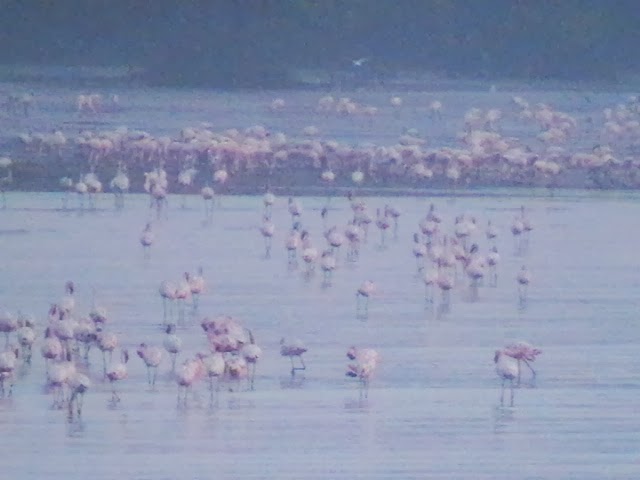
    The birds were very far and could be only viewed with spotting scope, below were few pics I was able to click with my cam.
     
    Sewri's birds will be one of the first victims of climate change in Mumbai, as rising seas claim the mudflats they inhabit. Pollution and unmanaged toxic waste already pose a grave threat to their survival. The Sewri Nhava Sheva sea link is planned straight through this precious natural bay and will devastate the mangroves, the mudflats, the birdlife and other species in this area. So if this project is implimented, Mumbai will be losing these creature.